

The Building Code of Australia (BCA) sets the technical rules found in Volumes One and Two of the National Construction Code (NCC). It defines minimum standards for safety, health, amenity and sustainability in Australian buildings. This article explains how the NCC and BCA work, how they’re enforced, and when projects follow Deemed‑to‑Satisfy provisions or use Performance Solutions. You’ll find practical guidance on core BCA areas like structural adequacy, fire safety, energy efficiency, and accessibility, plus a summary of recent NCC amendments that commonly affect residential and commercial projects. We also map typical compliance pathways and the specialist evidence often required, and describe Livit Construction’s hands‑on approach to managing approvals, consultant coordination and verification so projects stay compliant and buildable.
The National Construction Code (NCC) is Australia’s consolidated technical framework for building and plumbing. The Building Code of Australia (BCA) refers specifically to the technical provisions in NCC Volumes One and Two. The NCC sets Performance Requirements, which are the outcomes the law expects, while the BCA provides prescriptive Deemed‑to‑Satisfy (DTS) methods and guidance to meet those outcomes. States and territories adopt the NCC through their building regulations, and enforcement happens at multiple points: certifiers, building surveyors and state regulators review documentation, carry out inspections and assess final occupancy. Understanding how Performance Requirements and prescriptive solutions interact helps project builders pick the most efficient compliance route that satisfies regulators and protects occupants.
The NCC is published and maintained by the Australian Building Codes Board (ABCB) and comprises three volumes covering building and plumbing standards. Volume One applies to Class 2 to 9 buildings, things like multi‑residential, commercial and public structures, and it contains more complex fire safety, structural and accessibility requirements that often need specialist input. Volume Two covers Class 1 dwellings (houses and townhouses) and Class 10 ancillary structures, offering prescriptive provisions commonly used for routine residential work. Volume Three is the Plumbing Code of Australia (PCA), which governs sanitary plumbing and drainage. Correctly classifying a project against these volumes is an essential early step to identify applicable Performance Requirements and DTS paths.
In short: BCA = NCC Volumes One and Two, and the ABCB is the national steward that develops and updates those volumes through technical committees and consultation. The ABCB publishes the NCC as a model code; when states and territories adopt it, the NCC becomes enforceable regulation. The BCA text sets out the Deemed‑to‑Satisfy methods and technical provisions commonly used on projects. Put another way: ABCB → publishes → NCC; NCC → includes → BCA; BCA → prescribes → Deemed‑to‑Satisfy provisions and Performance Requirements. Builders and certifiers use this hierarchy to identify required evidence and inspection points, and to know which bodies or specialists to consult for novel design solutions.
The BCA groups technical obligations into core components that together deliver safe, functional and sustainable buildings. For practitioners, five areas drive most design and construction decisions: structural adequacy, fire safety, health and amenity, energy efficiency, and accessibility. Each area links to Australian Standards, specialist evidence and inspection checkpoints that should be assembled before and during construction to support approvals and handover. Spotting common pitfalls, such as under‑specified foundations, poor fire compartmentation, or inadequate thermal envelopes, lets builders plan inspections, engage certifiers early and reduce rework. The table below summarises these components in plain terms to support practical compliance planning.
How the main BCA components affect builders in practice.
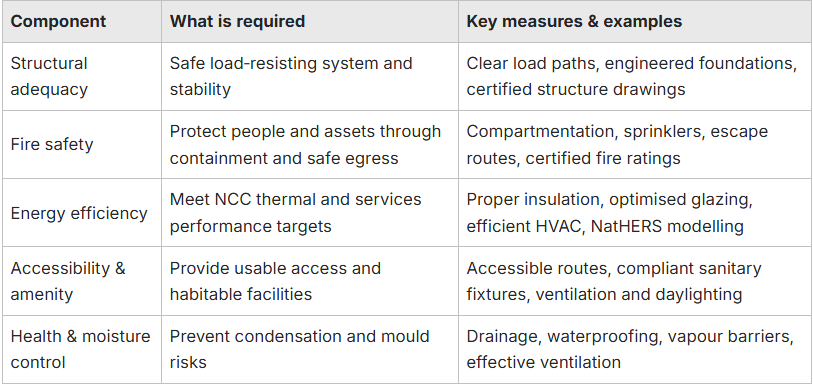
This table distils each major BCA area into practical checkpoints builders can use during planning and on site. The following subsections look more closely at structural adequacy, then at fire safety, energy efficiency and accessibility together.
Structural adequacy requires a load‑resisting system designed for gravity, wind and seismic actions and compliant with referenced Australian Standards. Builders usually confirm compliance with engineer‑stamped drawings, specified materials and controlled construction tolerances. Typical evidence includes structural calculations, milestone certifications (footings, framing) and engineer or certifier inspection reports. Common compliance failures stem from incomplete documentation, unapproved on‑site changes or missing lateral load details; early coordination with the structural engineer helps avoid those issues and speeds approval checks.
Fire safety, energy efficiency and accessibility are closely linked. They shape layout, materials and services and often require specialist input and testing. Fire safety covers passive and active measures: fire‑resisting construction, escape routes, detection and suppression, and in complex cases, formal fire engineering for façades or mixed‑use interfaces. Energy efficiency targets the building fabric and services: insulation, glazing choices and correctly sized HVAC supported by energy modelling or NatHERS assessments. Accessibility ensures equitable access through ramps, clearances and suitable sanitary layouts aligned with access standards. Addressing these topics early in design reduces costly changes during construction and streamlines approvals.
Building façades play a pivotal role in both fire safety and energy performance, which is an area of active research and regulatory focus.
Fire Safety & Energy Efficiency in Building Facades
Modern façades have evolved to meet aesthetic and energy performance goals, but those changes also alter how façades behave in fire. Poorly performing façade systems can contribute to rapid fire spread and serious building damage, as highlighted by incidents such as the Grenfell Tower fire. This paper offers a comprehensive review of international design guidelines and test methods for fire‑resistant façades, and discusses how cladding materials, façade geometry, cavities, wind effects and building spacing influence performance.
Performance of modern building façades in fire: a comprehensive review, KTQ Nguyen, 2016
The NCC provides two main compliance routes. Deemed‑to‑Satisfy (DTS) is prescriptive: follow the specified methods and you meet the Performance Requirements. Performance Solutions are outcome‑based: you must demonstrate, with evidence, that your alternative approach achieves the required outcomes. DTS works well for routine construction where the BCA gives clear dimensions and materials and is generally quicker to document and verify. Performance Solutions are chosen for innovation, deviations from DTS, or when a tailored, more efficient outcome is preferable; they need a documented solution, supporting reports and an agreed verification method with the relevant authority. The table below outlines typical pros, cons and evidence needs for each path to help builders choose the right approach for scope, time and budget.
Comparison of compliance methods: Deemed‑to‑Satisfy vs Performance Solutions.
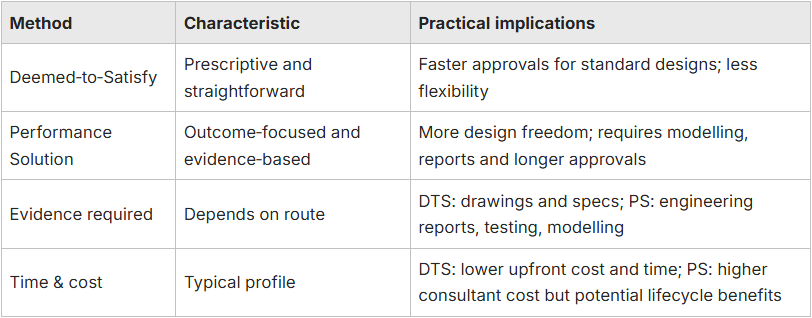
This comparison helps builders balance project objectives against regulatory expectations and decide when to commission specialist reports or testing. The next subsections outline typical DTS documentation and the practical workflow for Performance Solutions.
Livit Construction’s perspective: guiding clients through DTS and Performance Solutions.
We give clients clear, actionable advice when choosing between Deemed‑to‑Satisfy paths and Performance Solutions. Our process focuses on early identification of the relevant Performance Requirements, commissioning necessary engineering or fire‑engineering reports, and preparing verification documentation for certifiers. By coordinating consultant inputs and assembling concise evidence packages, we reduce approval delays and identify where DTS measures can control cost. Livit’s role is practical: we translate BCA requirements into buildable, compliant outcomes for our clients.
Deemed‑to‑Satisfy provisions are the BCA’s prescriptive options, which include specific materials, dimensions and construction methods that meet NCC Performance Requirements when followed exactly. Builders using DTS typically submit drawings, specifications and staged inspection reports that align with the listed provisions; certifiers verify compliance through inspections and documentation. DTS is ideal for typical building classes and routine details, like timber‑framed houses, straightforward fire separations, or standard sanitary installations, because it minimises the need for specialist modelling. If site conditions, materials or design intent fall outside DTS, the project builder should consider a Performance Solution to demonstrate an equivalent or better outcome.
Performance Solutions let project builders use alternative design approaches provided they demonstrate compliance with NCC Performance Requirements using robust evidence and verification. The process starts by identifying the relevant Performance Requirement, proposing a solution, and compiling evidence, such as engineering reports, fire engineering analysis, energy modelling, or expert judgement. Verification can include testing, peer review or benchmarking against accepted standards. Approval requires clear documentation that regulators can assess. Performance Solutions are common for complex façades, mixed‑use developments and innovative structural systems where DTS is impractical or suboptimal.
Recent NCC changes, especially NCC 2022 and the tightening expected in NCC 2025, put greater emphasis on energy performance, condensation risk management and livable housing/accessibility. These amendments shift focus toward measurable performance outcomes, stricter thermal envelope and services requirements, and refined fire safety provisions for complex façades and new materials. Practically, expect more requests for energy modelling, tighter documentation of moisture control details, and earlier specialist engagement to validate novel solutions. The table below compares key 2022 amendments with anticipated NCC 2025 changes and their likely impacts so builders can prioritise compliance actions during design and procurement.
Building energy codes can deliver big climate benefits, but only if enforcement and stakeholder engagement are strong.
Australian NCC: Energy Efficiency & Enforcement
Higher building energy efficiency can make a substantial contribution to greenhouse gas reduction. Building energy codes deliver economic, environmental and social benefits, and Australia’s construction rate makes the NCC a significant policy lever. Analyses of NCC reform show that energy codes are a cost‑effective way to reduce emissions, but their impact depends on effective enforcement and the behaviour of market participants.
The potential contribution of building codes to climate change response policies for the built environment, GM Morrison, 2020
A quick comparison of NCC amendments and their project impacts.
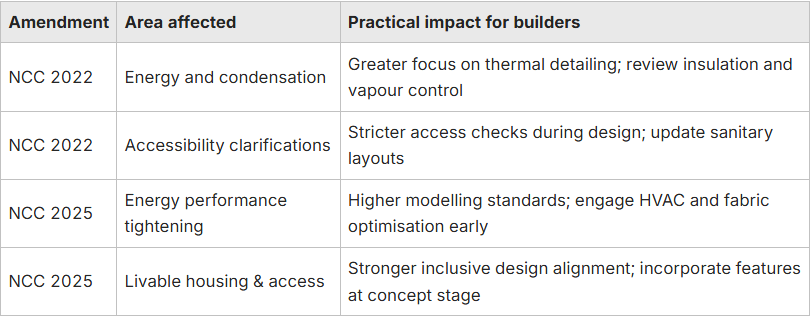
Overall, NCC changes are moving toward measurable environmental and accessibility outcomes, which drives earlier consultant engagement and stronger documentation practices. The sections below summarise the 2022 amendments and the anticipated priorities for NCC 2025.
NCC 2022 introduced targeted updates to energy provisions, condensation risk management and accessibility clarifications. Energy changes emphasised thermal performance and services efficiency, increasing the likelihood that energy modelling or supporting evidence will be requested at approval. Condensation measures required clearer documentation of vapour control layers, drainage paths and ventilation strategies to prevent moisture build‑up. For builders, immediate actions include auditing current details against the updated requirements, obtaining any additional certification or testing early, and aligning procurement with the required thermal and moisture‑control specifications.
NCC 2025 is expected to raise energy efficiency benchmarks, introduce more prescriptive verification methods and strengthen livable housing provisions to improve accessibility across housing types. Builders should prepare for higher minimum thermal performance, greater reliance on energy modelling to demonstrate compliance, and the inclusion of basic livability features at design stage rather than as retrofits. Practically, this means specifying improved glazing, insulation and HVAC efficiency earlier, engaging energy modellers during schematic design, and adding accessible design checklists to tender documents. Adjusting procurement and schedules to these changes will reduce variations and support timely approvals.
Livit Construction turns BCA and NCC requirements into disciplined workflows tailored to project class while maintaining consistent standards for approvals, documentation and on‑site verification. For Class 1 and 10 residential work we typically use Deemed‑to‑Satisfy routes where feasible, with clear construction sequencing and targeted checks for NCC 2022/2025 energy and condensation requirements. For commercial Class 2 to 9 projects, we prioritise early specialist engagement with fire engineers, structural engineers, and energy modellers to develop Performance Solutions and coordinate certifier interactions. Across both types, our approach emphasises design reviews, consolidated evidence packs for approvals, and staged inspections to demonstrate compliance and minimise scope creep. The checklist below outlines the typical touchpoints we use to keep projects on track.
Typical compliance touchpoints and procedures Livit Construction follows.
These operational steps form the backbone of Livit Construction’s compliance workflow and help minimise approval delays and on‑site variations. The following sections describe our residential and commercial approaches in more detail.
For Class 1 and 10 residential projects we usually prefer Deemed‑to‑Satisfy routes where they are practical, pairing clear construction specifications with targeted checks to meet NCC 2022/2025 energy and condensation requirements. Early tasks include validating envelope U‑values, specifying vapour control layers and confirming NatHERS or equivalent performance expectations, then embedding those details in tender documents and work instructions. Our residential checklist covers footing and framing certification, fire separations in multi‑dwellings, compliant sanitary layouts and basic livability features where relevant. This approach reduces surprises on site, streamlines certifier inspections and keeps client costs predictable while aligning with evolving NCC requirements.
Commercial Class 2 to 9 projects often need a Performance Solution mindset and multidisciplinary coordination. Livit assembles specialist builders early and establishes verification pathways with certifiers. Key activities include commissioning fire engineering for complex egress or façade treatments, engaging structural engineers for innovative structural forms, and using energy modelling to demonstrate compliance with tightened NCC metrics. Document management is central: we compile consolidated evidence bundles, such as engineering reports, modelling outputs, and proposed verification methods, to present to the certifier. This structured approach clarifies responsibilities, enables efficient approvals and supports construction sequencing that accommodates specialist testing and staged certification.
These workflows show how Livit Construction integrates technical compliance with practical build sequencing to deliver compliant residential and commercial outcomes while minimising rework and approval delays.
