

Brisbane’s house building regulations are the planning scheme rules, building codes and overlay controls that set out what can be built, where and how. They bring together the Brisbane City Plan 2014, state building codes and overlay requirements to manage zoning, assessment pathways, setbacks, heights and essential safety and sustainability standards. This guide helps homeowners, designers and builders spot the regulatory triggers, follow the practical steps to secure approvals in Brisbane, and identify common compliance checkpoints that slow projects. From a builder’s viewpoint, we translate rules into the documents, inspections and contract milestones you’ll encounter so you can better predict timelines and costs. Below we explain the City Plan’s role, give a step by step approval checklist, outline rules homeowners must follow (setbacks, height, overlays), cover sustainability and accessibility standards like NatHERS and Modern Homes, describe QBCC and certifier interactions, and summarise the legal and financial consequences of non compliance. Knowing these parts helps you plan designs that meet Brisbane’s expectations and work efficiently with certifiers and builders through approvals.
Livit Construction presents this guide from a builder’s perspective to turn technical requirements into practical actions for Brisbane builds. We frame the advice around common builder workflows, typical documentation and certifier coordination to streamline approvals. This is intended to show how regulatory steps play out on real projects, not to replace official council or state guidance. The focus is on actionable planning, pre lodgement checks and sensible risk reduction. The examples and workflow tips ahead show how builders minimise delays while staying compliant, and they help homeowners ask the right questions of designers, certifiers and contractors. With that context, the next section explains the core planning framework behind most Brisbane residential approvals.
Brisbane City Plan 2014: Construction Regulations and Compliance
Brisbane’s residential construction framework combines planning scheme provisions, state building codes and overlay controls to set the technical and planning requirements for houses across the city. The framework draws on the Brisbane City Plan 2014 alongside state regulations to govern zoning, assessment pathways, setbacks, height limits and the relevant safety and sustainability standards.
Brisbane City Plan 2014
The Brisbane City Plan 2014 is the city’s statutory planning scheme. It sets land use zones, assessment tracks and local development controls that directly shape house building rules. The Plan determines where residential development is allowed, which uses are permitted and whether a proposal is accepted, code assessable or impact assessable. In short, whether you need a development application and what criteria will be applied. Checking the City Plan early avoids surprises. Zoning and overlays fix the height envelope, setback requirements and often require extra reports (for example, heritage or flood studies). In practice, the City Plan is the legal baseline that links planning policy to the technical checks used in building approval. The subsections below unpack common zoning rules and show how zoning choices affect permit pathways and likely outcomes.
Key effects of the Brisbane City Plan 2014 include zoning that defines permitted uses, overlays that trigger special assessments, and development standards that set measurable limits (setbacks, height, site cover). Together these elements shape a site’s design envelope and the assessment track for each project.
Those impacts mean a homeowner’s first task is a site specific review of zoning and overlays to define required approvals and documentation. Knowing those triggers lets designers and builders tailor plans to the exact assessment track council expects.
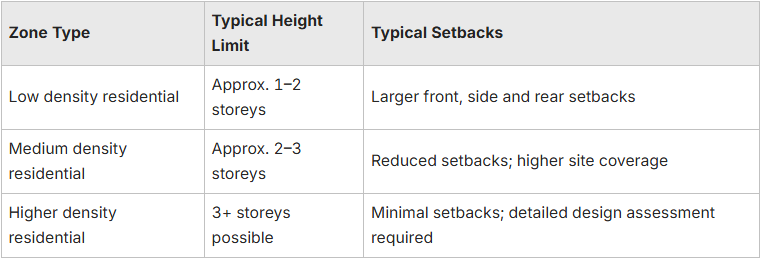
Zoning divides land into residential categories such as low density, medium density and higher density, each with typical permitted uses and controls. Low density zones generally suit detached houses and expect larger private open space and setbacks. Medium density zones enable duplexes and townhouses with reduced setbacks and higher site coverage. Higher density zones allow multi unit formats and usually demand more detailed design assessment. Zoning also indicates whether a development is likely code assessable (measurable standards) or impact assessable (judgement against broader planning criteria). Identifying the parcel’s zone clarifies which performance outcomes the proposal will be checked against and whether any departures will need formal justification. The next subsection describes how these zoning differences change permit steps and assessment timelines.
Knowing a parcel’s zone early shows whether a straightforward code path or a fuller impact assessment will be needed, which in turn affects design flexibility and documentation scope.
Zoning sets the assessment track, accepted, code or impact, and that determines the consent type and supporting material for a permit. For accepted or code assessable development, lodgement usually requires plans, engineering and basic reports that demonstrate measurable compliance. For impact assessable proposals you’ll need a more comprehensive development application and a statement against planning policies. Common decision points include whether proposed setbacks, height or site coverage meet the code; if they don’t, you’ll need impact reports or negotiations with council. Spotting these decision points during early design reduces the chance of post lodgement information requests and delays. When zoning triggers an impact assessment, expect longer timelines and extra documentation such as specialist reports or community notification, and plan your design and lodgement sequence accordingly.
When an impact assessment is required, build extra time into your program for specialist reports, community consultation and council review.
Brisbane urban consolidation and infill development policy
To limit urban sprawl, the Queensland Government has pushed an urban consolidation approach. For Brisbane the policy target is that a large share of new dwellings come from infill development within the existing urban footprint. Delivering this outcome changes dwelling types and the city’s urban fabric, encouraging greater density in established areas.
Department of Local Government, Infrastructure and Planning (policy references)
The building approval process in Brisbane moves a project from feasibility to occupancy certification through a sequence of planning and building checks. At a high level, planning approval (if required under the City Plan) is separate from building approval and code compliance under the Queensland Development Code and the Building Code of Australia. Early practical tasks like site assessment, design documentation, energy assessments and structural engineering form the application pack that private certifiers or council assessors review. Time is often lost when pre lodgement checks are skipped, so a structured workflow and clear responsibility for documents are essential. Below we give a step by step pathway and compare private certifier versus council approvals to help you choose the right route.
Below is a concise, common sequence used to obtain building approval in Brisbane.
This ordered process highlights important milestones and shows how proactive pre lodgement work shortens assessment time and reduces the risk of referrals or refusals.
Before a comparative table, here’s a practical summary comparing common approval routes (Council, Private Certifier, Owner Builder), their attributes and typical outcomes to help pick the right pathway.
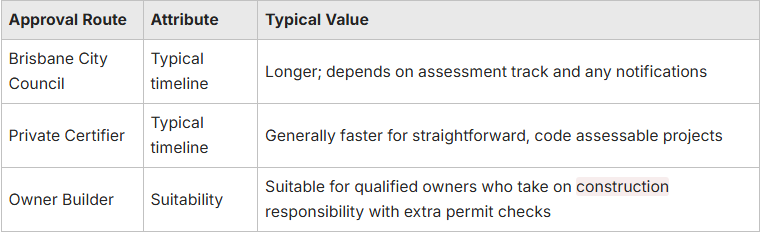
This table highlights how route selection affects schedule and risk. Picking the right approval path early shapes the documentation package and resource plan for the project.
A methodical checklist reduces surprises during approval and construction, starting with pre lodgement checks and ending with final certification. Begin with a planning check to confirm zoning and overlays and whether a development application is needed. Then progress to detailed design and specialist reports such as structural engineering and NatHERS assessments. Lodge either a development application (if required) and/or a building approval with the chosen certifier, respond promptly to information requests, and schedule mandatory inspections during construction to obtain the final inspection and occupancy certificate. Keep a document register and inspection schedule to avoid gaps between design, construction and certification. The next subsection compares private certifiers and council approvals to help decide the best route for your project.
Following these steps like site assessment, design, specialist reports, lodgement and inspections creates a repeatable workflow that reduces rework and supports timely certification.
Private certifiers and Brisbane City Council both ensure code compliance, but they differ in scope, responsiveness and practical suitability. Private certifiers often deliver faster outcomes for code assessable work and provide a single point of contact for building approval. Council assessments can be more thorough for complex or impact assessable proposals and may include public notice periods. Cost drivers include assessment fees, specialist reports and negotiation cycles; while private certifiers can speed things up, it’s important to choose one with the right experience for the project. For many single houses and small residential builds, private certifiers streamline approvals; for larger or contested developments, council assessment is often required. The list below summarises when each option is typically best.
To make the comparison practical, the table below summarises role, timeline and pros/cons for each approach.
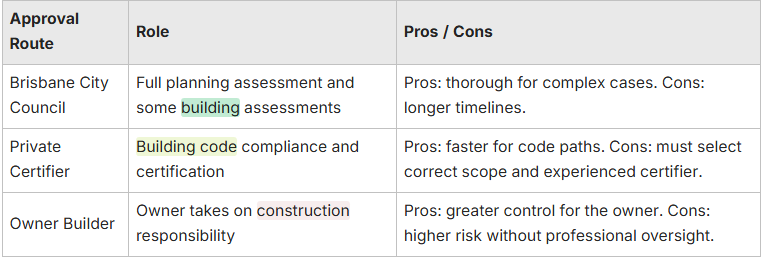
This comparison helps stakeholders match project complexity to the most appropriate approval path and plan resources accordingly.
Homeowners must meet measurable design controls like setbacks, height limits, site cover and any overlay specific requirements that together define the allowable building envelope for a lot. These rules determine minimum distances from boundaries, maximum building heights and the share of the site that can be built on, with variations by zone and overlay. Overlays such as heritage and flood change permissible outcomes and the supporting documentation required; other controls address external materials, privacy and overshadowing in certain residential contexts. Worked examples, tables and the following subsection on height and setback calculations help translate these controls into design checks you can apply to a specific lot.
Understanding how numeric and qualitative controls interact lets designers shape compliant envelopes that meet both regulation and client expectations.
Height and setback rules define the three dimensional envelope a house must fit into and are measured using methods set out in the planning scheme. Setbacks typically cover front, side and rear distances measured from property boundaries to habitable building elements. Height is measured from a defined ground level to the highest point of the roof or parapet under the planning definitions. Low density zones usually require larger setbacks; medium density zones allow reduced setbacks and greater site coverage; height controls reflect the expected number of storeys for a zone. A practical approach: confirm the zone, apply the zone’s setback and height parameters, then draw the building envelope on the site plan to check compliance before lodgement. The next subsection outlines how overlays add extra constraints that often need specialist reports.
Measuring height and setbacks during concept design prevents costly redesigns and post lodgement variations.
To compare typical zone controls across common residential zones, the table below summarises typical height and setback characteristics by zone type.
Heritage and flood overlays add assessment steps and specialist documentation beyond standard zone controls. Heritage overlays often require a heritage impact statement and design approaches that conserve character; flood overlays commonly need a flood impact assessment, raised floor levels or flood resilient construction methods. These overlays can move a proposal from code assessable to impact assessable because they introduce performance criteria that rely on expert judgement rather than simple numeric checks. Practical responses include commissioning heritage or flood engineering advice early and embedding mitigation into the concept design to avoid late redesigns. Typical plan adjustments where overlays apply include raised slab heights, flood resilient materials and facade treatments that respect heritage values, all documented clearly to satisfy overlay objectives and speed consent. Common mitigation strategies builders use when overlays apply are below.
Addressing overlays proactively reduces assessment friction and positions the project for a smoother consent outcome.
Queensland links sustainability and livability standards to building approvals for new homes, covering energy performance, thermal comfort and accessibility. NatHERS energy ratings assess thermal performance and guide insulation, glazing and passive design choices. Modern Homes standards promote accessible, liveable design features that make homes usable across life stages. These standards are demonstrated through assessments, documentation and construction details that meet prescribed performance thresholds. Designers should commission NatHERS assessments early in design and include accessibility features where Modern Homes or similar incentives apply. The subsections below define NatHERS and outline common Modern Homes features builders typically deliver to meet contemporary expectations.
Meeting these standards early avoids costly retrofits and supports compliance with planning and building code requirements.
The NatHERS energy rating evaluates a dwelling’s thermal performance using accredited simulation software. It produces a score that reflects expected heating and cooling needs and indicates the measures required, such as insulation levels, window performance and shading, to meet the target. Common ways to improve a NatHERS score include optimising orientation, increasing insulation, specifying higher performance glazing and designing for cross ventilation. NatHERS assessments are usually completed during detailed design so plans submitted for approval can demonstrate how the required rating will be achieved; they also guide construction detailing to match the modelled outcomes. The key features most NatHERS compliant designs include are listed below.
Commissioning a NatHERS assessor early reduces redesign risk and supports predictable compliance at lodgement.
To compare sustainability and accessibility standards and how they’re typically implemented, the table below outlines key standards, requirement levels and common compliance features.
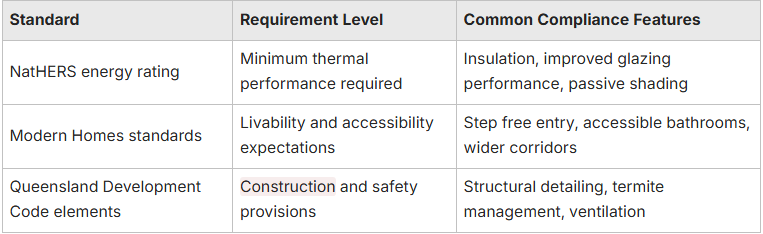
The Modern Homes standards encourage accessible design features that improve usability for a wide range of residents: level access, adaptable bathrooms and circulation space that accommodates mobility aids. Design implications include planning entries without steps where feasible, future proofed bathroom layouts and space for accessible fixtures and door widths. Including these features early means structural and service layouts can be designed around accessible thresholds without costly retrofits. Considering accessibility at concept stage also supports resale value and long term resilience, showing how regulatory compliance and market expectations align for modern homes.
Incorporating livability features early meets regulatory aims and delivers practical, long term benefits for homeowners and future occupants.
Brisbane builders work with the Queensland Building and Construction Commission (QBCC) and private certifiers to confirm licences, maintain construction standards and secure approvals and inspections. The QBCC regulates licensing, provides owner builder guidance and runs dispute resolution processes; private certifiers conduct building code assessments and onsite inspections required to issue approvals and occupancy certificates. Effective collaboration needs clear roles, timely document exchange and inspection schedules aligned with construction milestones. Best practices include verifying licence status, keeping thorough documentation, and maintaining open lines with certifiers to avoid inspection bottlenecks. The subsections that follow explain QBCC’s role and offer tips for selecting and working with private certifiers.
Understanding QBCC and certifier roles helps allocate responsibilities and prevents regulatory gaps during construction.
The QBCC provides regulatory oversight for licensing, contractor conduct and owner builder permit processes, and it publishes guidance and resources on compliance. Its remit includes licensing builders and trades, offering standards guidance and helping homeowners with permit, warranty and dispute matters. For owner builders, QBCC sets eligibility criteria and documentation requirements for permits and managing risk. Builders on Brisbane projects use QBCC resources to confirm licences and align contractual and insurance arrangements with regulatory expectations. Knowing QBCC’s role clarifies where certifier and builder responsibilities overlap and when homeowners should seek additional professional advice.
QBCC oversight creates accountability across the design and construction process and protects consumers.
A well chosen private certifier and good process reduce delays and ensure inspections and documentation are scheduled and completed on time. Selection criteria include experience with the project type, a clear scope of services, responsiveness to information requests and familiarity with local City Plan interpretations. At lodgement, provide a complete application pack, including site plans, engineering, NatHERS report and any overlay specialist reports, to minimise follow up requests. Communication best practices include agreeing inspection windows up front, using a document register to track revisions and confirming certification milestones in writing. Livit Construction’s typical workflow emphasises early pre lodgement checks, consolidated documentation bundles and a scheduled inspection plan to coordinate trades and certifier availability without disrupting the construction timeline.
Careful certifier selection, complete lodgement packages and proactive scheduling reduce approval friction and help secure timely certification.
To help decision making, here’s a short checklist for certifier selection and documentation best practice.
Following these steps helps align inspections and approvals with construction sequencing and budget expectations.
Compliance protects legal standing, financial investment and occupant safety by ensuring designs meet planning, structural and safety standards. Non compliance can lead to fines, remediation orders, insurance issues and delayed or denied occupancy. Staying compliant reduces risk, supports resale value and improves long term durability and energy performance. Practically, working to code and providing required documentation reduces disputes and creates a defensible record of due diligence in case of warranty or planning queries. The next subsection outlines legal and financial risks of non compliance and explains how a builder focused compliance workflow reduces those risks.
Maintaining compliance aligns construction with regulatory expectations, mitigates downside risk and preserves the value and safety of the completed home.
Non compliance can trigger enforcement actions such as fines, orders to rectify or even demolition of non compliant work, and may void insurance or complicate mortgage and resale transactions. Remediation costs and legal fees can easily exceed any savings from cutting corners, and lenders or insurers may refuse cover for unapproved works. If non compliance is discovered, immediate steps include stopping affected work, seeking professional advice from a certifier or solicitor, and preparing a remediation plan to present to authorities. Practical next steps owners and builders should take are listed below.
These actions help contain risk and present a clear remediation pathway to regulators and insurers.
Livit Construction approaches compliance with a documented workflow that integrates early site and zoning analysis, consolidated documentation at lodgement and a scheduled inspection plan to align trades, certifiers and milestone dates. Key elements include a pre lodgement checklist to verify zoning and overlay triggers, commissioning NatHERS and other specialist reports before formal lodgement, maintaining a project document register and appointing a single compliance coordinator to liaise with certifiers. These practices reduce information requests, minimise inspection delays and create a clear audit trail for approvals and final certification. For homeowners this workflow means fewer surprises, clearer timelines and assurance that design and construction align with the Brisbane City Plan 2014 and relevant state codes. If you need a qualified certifier or builder contact, reach out to a licensed local practitioner or use Livit Construction’s workflow as the standard you should expect from a professional builder during approvals.
This builder focused compliance approach emphasises proactive documentation, close coordination with certifiers and scheduled inspections to shorten approval times and reduce regulatory risk.
