

Flood hazard areas in Queensland are parcels of land that can be inundated by river, coastal or stormwater events. Regulations and resilient design work together to reduce risk to people, property and infrastructure. These controls set Defined Flood Levels (DFL), require minimum finished floor levels and specify construction responses so buildings stay safe, repairable and compliant.
This guide explains how Queensland Development Code MP 3.5, the Building Act 1975 and local planning instruments fit together. You’ll learn how to find flood overlays in South East Queensland, what Flood Impact Assessments (FIAs) involve, and the practical, builder focused approaches Livit Construction recommends, such as elevated sub floor systems to wet proofing and dry proofing. We also cover the approval pathway for flood prone land, typical timelines and the professionals to engage to keep your project on track.
Livit Construction’s advice below is grounded in hands-on delivery of flood resilient projects in Queensland. We focus on coordinating design to permit, using construction methods aligned with QDC MP 3.5, and prioritising repairability so occupants can return sooner after an event.
At state level, QDC MP 3.5 sets the technical performance requirements for buildings in identified flood hazard areas. The Building Act 1975 enforces building approvals and the Planning Act 2016 determines when development approval is needed. MP 3.5 spells out when flood controls apply, the minimum finished floor levels relative to the DFL, and the construction measures expected to reduce risk and damage. Understanding how state code and local planning overlays interact is essential to predict permit conditions and required documentation. Practical triggers and outcomes are summarised below.
These core points lead to the detailed MP 3.5 clauses an assessor will check at building approval. We cover those checks next.
MP 3.5 sets minimum performance outcomes for development in flood hazard areas. Key obligations include siting finished floors above the Defined Flood Level (with any required freeboard), using flood tolerant materials below the design flood, and detailing structural systems that either resist inundation forces or let water pass through without causing collapse. Certifiers typically expect evidence such as surveyed floor level certificates, structural details for elevated foundations and material/service locations.
A common trigger is a change of use or increase in habitable floor area that places more space below the mapped DFL. That usually prompts an FIA and code assessed solutions. Knowing these specifics helps builders decide whether elevation, wet proofing or dry proofing is the most appropriate approach and what documentation to prepare for approval.
MP 3.5 operates inside the statutory framework set by the Building Act 1975 (technical approvals) and the Planning Act 2016 (land use and development assessment). In practice, a council flood overlay can trigger a development application under the Planning Act, with conditions and mapping from planning feeding into the building approval where MP 3.5 requirements are enforced. Certifiers and assessors expect alignment between planning conditions and the technical building documentation.
Local planning schemes sometimes add overlay controls or locally specific requirements. Early coordination between planners, certifiers and builders reduces rework and ensures the design meets both MP 3.5 and any additional local criteria, a practical point we return to in the permitting section.
The policy background and its evolution matter. Past reviews of Queensland’s flood planning help explain why robust, coordinated planning frameworks are now central to managing flood risk.
Queensland flood mitigation policy and planning
Reviews of Queensland’s flood planning, including State Planning Policy 1/03, analyse how policy changes after major events have shaped flood mitigation and land use controls across the state.
Flood hazard mapping for South East Queensland (SEQ) is maintained by state agencies and by local councils. Overlay layers show risk categories, Defined Flood Levels (DFL) and the hazard type (riverine, coastal or overland flow).
To find and interpret these maps, check the relevant council’s planning portal for the property, turn on the flood or overlay layers and read the map legend for DFL references and hazard categories. Use the practical checklist below to confirm site level risk and whether a more detailed assessment is needed.
Map symbology and DFLs also tell you which council manages updates and how frequently maps are reviewed; the next subsection explains council roles and common variations across SEQ.
Start at the local council’s planning portal and enable flood or overlay layers. Map pop ups or property reports usually show the overlay type and any numeric DFL values. If numeric DFLs aren’t shown, consult the council’s mapping documentation or GIS metadata for the controlling flood event (for example, 1% AEP) and datum used.
Where mapping is ambiguous or development sits near overlay boundaries, a site specific FIA and survey will provide a certified DFL and reduce the risk of approval delays. Confirming overlay combinations early helps decide whether elevation, drainage works or other measures are required and prepares you to brief the right specialists.
Local councils publish and apply flood overlay maps in their planning schemes and assess development applications against local provisions and state codes like MP 3.5. Councils issue mapping updates, offer policy interpretation and provide pre lodgement advice to clarify the likely scope of any FIA or hydrology input.
Councils vary in overlay definitions, update frequency and approval conditions. When in doubt, arrange a pre lodgement meeting with council planning officers to align expectations and speed up the formal assessment.
Effective flood resilient design combines elevation, material selection and service layout to reduce damage and speed recovery. Livit Construction prioritises solutions that meet MP 3.5, lower long term repair costs and shorten downtime. Our three principal approaches are elevating habitable floors above the DFL, designing for controlled inundation or dry proofing where appropriate, and specifying durable, easily replaced materials for lower levels and services. Below are the core approaches and a comparative table to help match technical triggers to practical choices.
The table below compares common foundation approaches so owners and design builders can match a solution to DFL triggers, cost considerations and recovery profiles.
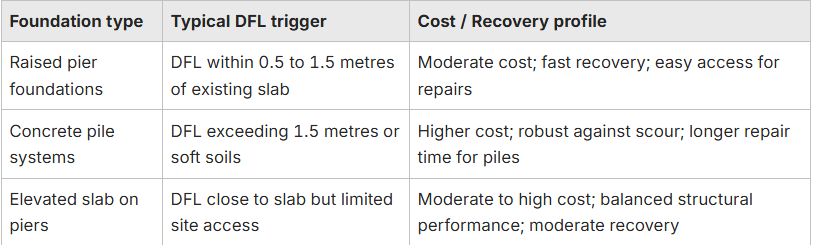
Raised pier systems often provide a cost effective balance of compliance and fast recovery, while deeper pile systems suit higher DFLs or unstable soils. Our design preference is for solutions that meet MP 3.5 triggers while keeping replacement elements modular and accessible for repair.
Elevated sub floor systems, like timber or concrete piers, driven or bored piles, lift habitable floors above the DFL and allow floodwaters to pass under the building. Choosing between piers and piles depends on DFL depth, soil conditions and lateral load requirements. Piers are cost effective for modest elevations; piles offer greater resilience where scour or deeper floods are likely.
Key construction details include corrosion resistant connections, routing services above the DFL and providing underfloor access for inspection and repairs. Accessible elevated systems reduce post event downtime because wet finishes and services can be isolated and replaced without major structural works.
Evidence from the field and research supports property level measures such as elevation for reducing vulnerability and improving recovery outcomes.
Flood resilient construction and elevated foundations
Research into property level flood resilience highlights how elevated designs and resilient materials can reduce damage and speed recovery, while also pointing to design details that influence long term performance.
Choosing the right elevated system requires coordinated geotechnical and structural input. Livit Construction routinely brings these specialists together so site DFLs translate into practical, buildable foundation solutions that meet MP 3.5.
Wet proofing accepts temporary inundation and uses materials that withstand water exposure, for example cementitious linings, flood grade cladding and sacrificial finishes, so load bearing elements remain intact and non structural finishes are simple to replace.
Dry proofing aims to prevent ingress with sealed barriers, raised thresholds and protected openings. It works for low depth or short duration events but can be compromised in prolonged inundation, so weigh the likely flood characteristics before relying solely on dry proofing.
Service strategies include placing switchboards and HVAC above the DFL, using waterproof junction boxes where unavoidable, and designing plumbing/drainage to reduce backflow risk. We emphasise repairability: specify water tolerant materials below the DFL and modular service layouts to speed return to use after flood events.
These material and technique choices help reconcile MP 3.5 performance outcomes with lifecycle cost and maintainability, guiding owners toward pragmatic, maintainable designs.
Approvals for development on flood prone land generally follow a clear sequence: pre lodgement enquiries, site survey and assessment, commission an FIA (if required), lodge planning and building applications, respond to conditions, then certification and construction compliance.
Each stage assigns responsibilities to the applicant, consultants, council or referral agencies and has predictable timeframes that are easier to manage with early coordination. The checklist below outlines the core permit stages and typical requirements so builders can prepare documentation and timelines.
The table below maps these steps to likely parties and expected durations so project builders can plan procurement and approvals.
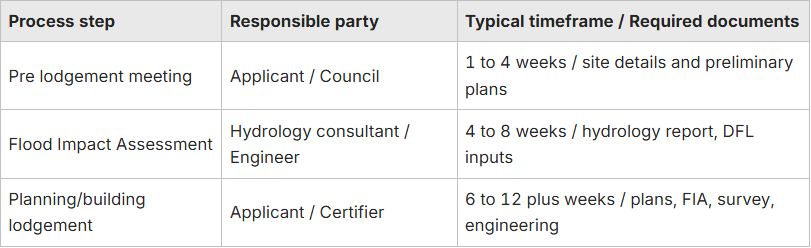
Common bottlenecks are FIA turnaround and council queries. Early commissioning of technical consultants reduces total approval time and avoids rework. The next section covers the steps to secure permits and complete an FIA.
Start by confirming mapping and arranging a pre lodgement meeting. Agree the FIA scope with your consultant and confirm council expectations so the assessment addresses hydraulic modelling, setting the DFL and downstream impacts.
An FIA typically includes hydrological analysis, flood routing and recommended finished floor and site works. Finalise the FIA and lodge it with your planning/building applications.
Delays often come from incomplete survey data or an FIA that doesn’t match council expectations. Providing accurate site surveys, existing floor levels and the relevant council mapping up front shortens review cycles. Projects that coordinate surveyors, hydrologists and certifiers early, ideally under one project lead, see fewer information requests and faster conditional approvals.
A clear, complete FIA package accelerates assessment and helps ensure the design is assessed consistently against MP 3.5 and any local conditions.
A standard project builder for flood prone land includes a hydrologist/engineer for the FIA and structural design, a surveyor for level datum and finished floor certification, a town planner for development approvals, a certifier for building approvals and a builder for constructability and cost advice.
Typical engagement points: surveyor and hydrologist at concept, planner before lodgement, certifier during detailed design and builder during documentation and pre construction.
Typical durations: FIA and engineering reports 4 to 8 weeks, planning assessment 6 to 12 weeks, and building approvals vary with certifier response and project scope. To streamline approvals, Livit Construction recommends early coordination of these professionals and can provide project coordination to keep technical outputs aligned with construction details.
Bringing the consultant builder together early reduces scope gaps, lowers rework risk and helps ensure the final design meets MP 3.5 in both documentation and buildability.
Investing in flood resilience reduces repair costs, shortens recovery time and can improve insurance outcomes. In short, resilience is both risk management and cost management.
Measures such as elevated floors, tougher materials and relocating services reduce expected annual damage, minimise downtime and often improve insurability. The table below summarises common measures, their benefits and indicative payback ranges to help owners compare options.
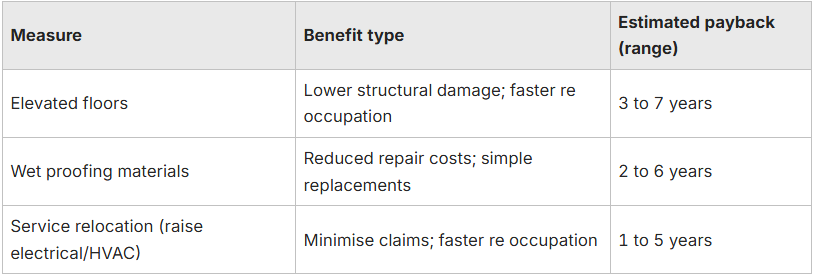
These illustrative ranges show many resilient measures can pay back over a relatively short horizon when compared with avoided repair costs and reduced downtime. The next subsection covers insurance and recovery implications.
Insurers look favourably on documented resilient measures, like compliance with MP 3.5, certified raised finished floors and use of flood tolerant materials, when assessing risk and claims. Clear evidence of resilient construction can support smoother claims and help stabilise premiums over time.
Resilient design limits water damaged finishes and services, enabling quicker repair and re occupation. For example, raised switchboards or modular finishes that are easy to replace.
To maximise insurer recognition, retain certifications, FIA reports and material specifications in the building record. These documents make it easier to demonstrate that the property was designed and built to limit flood damage, improving administrative and financial recovery after an event.
Some programs and grants exist to support resilience upgrades, improving the benefit cost of measures like raising floors or upgrading materials. Availability and eligibility change, so check current program status before relying on incentives.
Conservative payback examples for combined upgrades (elevated floors plus service relocation) often fall within 3 to 7 years when factoring avoided damage and faster re occupation; single measures such as raising electrical services can have shorter paybacks.
Verify grant eligibility with the administering authority before including incentives in project funding plans. Combining available incentives with sensible design choices can shorten payback periods and make resilience a financially sound decision for many owners.
Livit Construction’s experience in flood resilient building in Queensland focuses on balancing code compliance, repairability and cost effectiveness. We coordinate technical inputs and deliver elevated or resilient builds that align with MP 3.5 and local planning expectations. If you want help, engaging a builder experienced in coordinating FIAs, engineering and certification can reduce approval time and deliver a resilient outcome that minimises future disruption.
